Privacy-First Note Taking: Why It Matters
Published on May 18, 2025
When it comes to digital tools, privacy is not optional — it is a fundamental right. In a world where data breaches make headlines weekly, where tech companies build detailed profiles of their users, and where personal information is routinely bought and sold, choosing a privacy-first tool for something as personal as note-taking is more important than ever. Your notes are not just text on a screen. They are your thoughts, your plans, your secrets, and your ideas. They deserve protection.
What Does "Privacy-First" Really Mean?
The term "privacy-first" gets thrown around a lot in marketing, but at KeepNotes, we define it with concrete actions rather than vague promises. A privacy-first application meets these specific criteria:
- No tracking: The app does not collect data about your behavior, your device, your location, or your writing habits. There are no analytics scripts watching what you do.
- No profiling: Your data is not used to build a profile about you. It is not fed into machine learning models, sold to advertisers, or shared with third parties.
- Minimal data collection: The app only collects information that is absolutely necessary for it to function. For KeepNotes, that means your note content and, if you choose to register, your email address. Nothing more.
- Strong encryption: Data is encrypted both in transit (using HTTPS/SSL) and at rest (using server-side encryption). Even if someone gained unauthorized access to the server, your notes would be unreadable.
- User control: You decide what happens with your data. You can delete your notes, remove your account, and export your content at any time.
Why Notes Are Especially Sensitive
Think about what you write in your notes. Unlike public social media posts or professional emails, notes are where you think freely and honestly. They contain raw, unfiltered thoughts that you would never share publicly. Consider the types of content that commonly appear in personal notes:
- Personal journal entries and emotional reflections
- Financial information, budgets, and account numbers
- Health-related notes, symptoms, and medication schedules
- Passwords, PINs, and security questions
- Business ideas, strategies, and competitive analysis
- Private conversations, drafts, and unsent messages
- Legal notes, contracts, and sensitive correspondence
Each of these categories contains information that could be harmful if exposed. A note-taking app that does not prioritize privacy is essentially an open book waiting to be read by the wrong person. Treating your notes with the same level of security as a password manager is not paranoia — it is common sense.
The Problem with "Free" Apps
There is a well-known saying in the tech industry: if you are not paying for the product, you are the product. Many free note-taking apps and productivity tools sustain themselves by collecting user data and selling it to advertisers. They offer a convenient service on the surface while quietly building detailed profiles of your interests, habits, and behaviors.
Some apps scan your note content to serve you targeted advertisements. Others share usage data with third-party analytics services that aggregate information across multiple platforms. A few even retain access to your content after you delete your account, using it for machine learning training data.
KeepNotes takes a fundamentally different approach. The service is free because it is lightweight and efficient to operate, not because your data subsidizes the business. There are no ads in the note editor, no data sales, and no third-party trackers embedded in the application.
How KeepNotes Protects You
KeepNotes implements multiple layers of protection to ensure your privacy:
- No trackers or analytics in your writing space: The note editor is completely free of tracking scripts. No one is watching what you type, how long you type, or what topics you write about.
- No cookies for anonymous users: If you use KeepNotes without creating an account, no cookies are placed in your browser. You leave no trace.
- SSL encryption by default: All data transmitted between your browser and our servers is encrypted using HTTPS. This prevents anyone on your network, including your ISP, from reading your notes in transit.
- AES-256-CBC server-side encryption: Note content is encrypted on the server using military-grade AES-256-CBC encryption. Even if the database were somehow accessed by an unauthorized party, your notes would appear as meaningless encrypted data.
- Bcrypt password hashing: If you set a password on a note, it is hashed using bcrypt before storage. Bcrypt is deliberately slow and resistant to brute-force attacks, making it extremely difficult for anyone to crack your password.
- Session-based storage for anonymous users: Notes created without an account are linked to a random slug, not to any identifying information. There is no way to connect an anonymous note back to its creator.
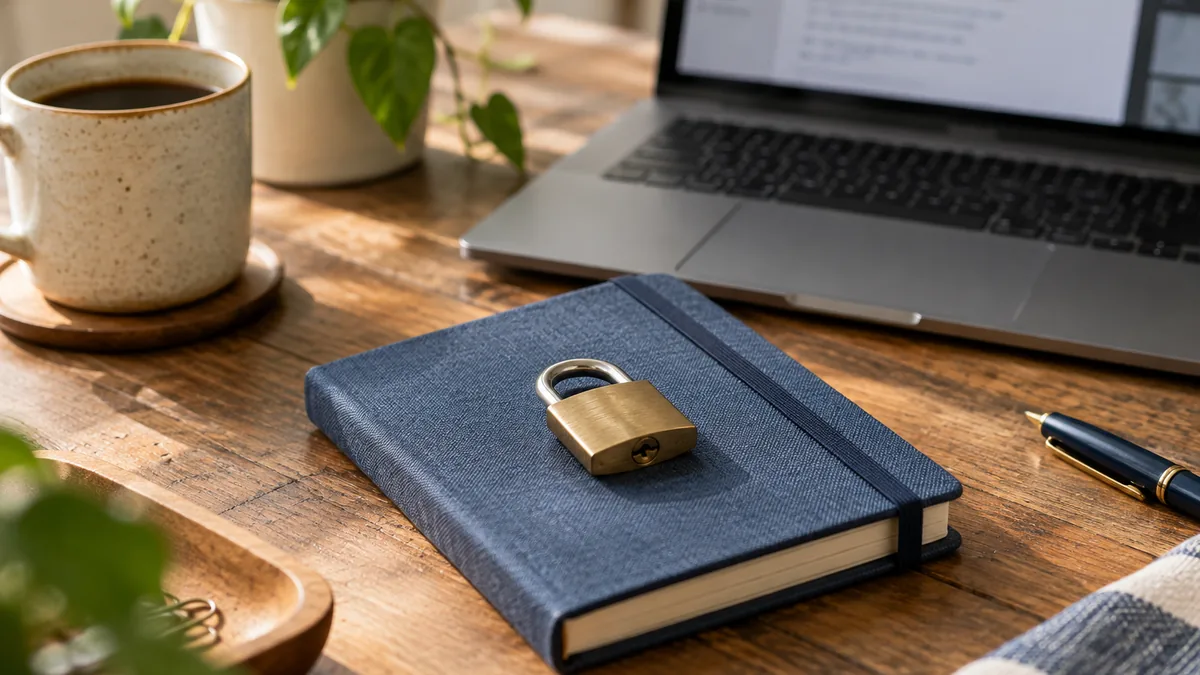
- Optional per-note password protection: Add an additional layer of security to any note by setting a password. The note content is only revealed after the correct password is entered.
Privacy in Practice: Real Scenarios
Let us look at how KeepNotes' privacy features protect you in everyday situations:
Using a public computer: You need to jot down a quick note at a library or internet cafe. With KeepNotes, you can write your note, bookmark the URL, and close the browser. No cookies are left behind, no account session persists, and the note is only accessible to someone who knows the specific URL.
Sharing sensitive information: You need to send your home Wi-Fi password to a house guest. Create a password-protected note with the information, send the note URL through one channel and the password through another. After the guest has retrieved the information, you can delete the note entirely.
Personal journaling: You maintain a daily journal that contains deeply personal thoughts. Password-protect the journal note and write freely, knowing that even if someone discovers the URL, they cannot read your entries without the password.
What We Do Not Do
Sometimes it is just as important to understand what a company does not do with your data. Here is our commitment:
- We do not sell, rent, or share your data with any third party.
- We do not use your note content for advertising, machine learning, or any purpose other than displaying it back to you.
- We do not retain your data after you delete it. When you delete a note, it is permanently removed from our systems.
- We do not require personal information to use the service. You can write notes anonymously without providing a name, email, or phone number.
Your Notes Stay Yours
Whether you are writing a journal, saving a private to-do list, planning a surprise, or documenting sensitive business information, your notes should belong to you and only you. At KeepNotes, privacy is not a feature we added as an afterthought — it is the foundation on which the entire platform is built.
If you care about privacy — and we believe you should — KeepNotes.online is the right space for your thoughts.